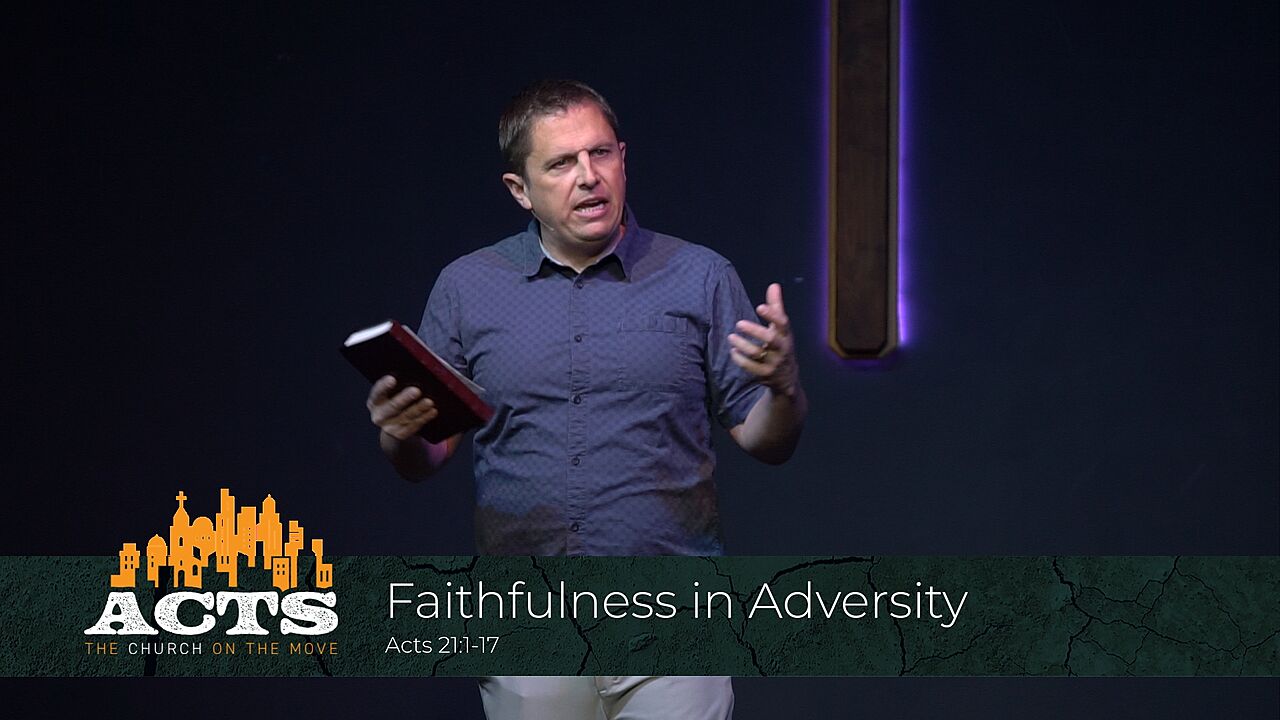
Acts 20:17-38 - Living Well

I'm going to invite you this morning to Acts chapter 20 is where we're going to be together today. Acts chapter 20 and this section of the Book of Acts, a beautiful section, very endearing section. It's probably, I don't know if I have a favorite section in the book of Acts, but if this isn't it, it's certainly one of the, one of the top tier sections for me. And the way that Paul is composing himself in this moment, especially in terms of his relationship with the church of Ephesus, if you remember here in Acts chapter 20, he's making his final stop in the city of Miletus on his way back to Jerusalem. And he invited the leaders of Ephesus to join him, visit him in Miletus as he's preparing to go to Jerusalem. And so this is really Paul's last stop of his final missionary journey in the in the book of Acts and out of his three missionary journeys from this point on, Paul goes to Jerusalem. He's arrested and he spends the rest of his time being in imprisonment. And that's how we end the book of Acts. So here he is, the final moments in Acts chapter 20 of his third missionary journey. And he's stopping in the church of Ephesus, which we talked about together. Church of Ephesus was one of the most influential churches in the first century, if not the most influential church. Paul spent more time here in Ephesus than among any other church where he planted churches.
And so this is a very loving church to the Apostle Paul. And it's not because it was absent of adversity. He certainly went through some challenges. But Paul deeply loved this church. And in fact, if I just kind of open this up by sharing with you the very beginning of this section in Acts chapter 17, and then we looked at the very end of this section. We can just see how endearing this was to the apostle Paul, because it says to us now from Miletus, he sent to Ephesus and called the elders from the church to come to him. If you remember, on Paul's third missionary journey, he didn't go visit anywhere new. On his third missionary journey, the apostle Paul visited all the churches that he saw established on his first and second missionary journey. And now he's coming eastward, back towards Ephesus, on his way to Jerusalem. And as he's on this journey, he's just left the region of Macedonia and Achaia, which have the towns of Philippi and Thessalonica and Corinth and Athens and some of those cities. You read, have letters to them in your New Testament letters, like the book of Philippians. The book of Thessalonians has a couple letters, the book of Corinthians, which is from the town of Corinth. So Paul is leaving this region, heading back east, trying to get to Jerusalem by Pentecost.
So he's in a bit of a hurry because his days are numbered before that celebration is about to take place. And he stops off at Miletus rather than going to the city of Ephesus. And the reason he does this is because I think the apostle Paul knows if he goes back to Ephesus, he's going to be there a while because he's got such such a close friendship with this community and with the church that's there, that Paul knows if he gets anywhere near that he's going to be he's going to be there for a minute. It's like me as a husband when I when I'm trying to get my wife out of places, I'm like, all right, dear, we go into this, I've got to get out of here by 9:00. She says, I know. Okay. And then it just it just does not happen. That's just when Paul knows his departure out of Ephesus. I'm not going to go that way. And so he invites the leadership down to Miletus. And then at the end of this, you see how close, how closely connected Paul is with this church. Because in verse 36 it says, and when he had said these things, he knelt down and prayed with them all, and there was much weeping to on the part of all. And they embraced Paul and kissed him. Now I want you to know, as a church, we don't practice this, okay? Like I learned my lesson one time, I started to.
I started to tease about this. The Holy kiss in the New Testament. I know some cultures might practice something similar to this today, and we do not. Just like I even said to us like I'm good fist bump handshake, we can even come in for a bro hug. You know, three pats back away can do more than three pats. It gets weird when it gets and like, I just shared that with us last time and we talked about a holy kiss and someone took it upon themselves to help me experience that it was another dude. And they leave. Yeah, yeah. So I learned I'm not going to, I'm not going to bring this up anymore. This is just this is a verse in the Bible, okay? But we just don't do that. But you see, you see Paul in this passage, he, he's caring deeply for the community that's here. Verse 38, being sorrowful most of all because of the word he had spoken, that they would not see his face again, and they accompanied him to the ship. So Paul, here he is saying in this passage that this is the final moment he's going to spend with this church and this community. Deeply loved Paul. Paul deeply loved them and being one of the most influential churches. And we talked about Timothy. He was a pastor of the church in Ephesus.
The Apostle John was here in the church of Ephesus. There are some traditions that teach. Even Mary, Jesus's mother spent her final days in this church, a very influential place. And it's in the midst of Paul's departure that we're just reminded of the quality of friendship that they had, that what they had as a community was tremendously special. And even for us, when we see this here in the 21st century, when we look at the influence of the church of Ephesus and the wealth of this community and the way they represented Jesus and influenced communities around them. We should look at this and think, man, whatever. Whatever happens in these final moments, these are these are Paul's final words with this community that he's about to spend time with. What made it so sweet? What were Paul's final words? What is it we can we can learn in these final thoughts that Paul shares. And, as you look at this passage, one of the things I think is important is the Apostle Paul, as you read through the book of Acts, one of one of the things that you discover is most of Acts is written to a about an unbelieving world. How as Peter and Paul traveled around the world, their interaction with an unbelieving world. And the messages are primarily tailored to how to best communicate with an unbelieving world. But in this particular chapter, this is one of the only sections in the book of Acts, and the longest section in the book of Acts, where Paul actually communicates to the believers and what is it God has for us? And.
And seeing the quality of what Paul has here, how do we discover that as a community? You know, I recognize the world around us today. I realize that people are desperate for relationship and quality of relationship that people. Today it seems more than in any other time, just feel lonely and lost in that loneliness and longing for more. And part of the reason we're like that as human beings is because it's the way that God designed us. Like we're created in the image of God, which says, being made in God's image, we're made for a relationship with the Lord. But even in that relationship, one of the things we recognize in being made in the image of God is that God is a triune being. And from the beginning he's existed father, son, and spirit. God has existed in community and being made in the image of God. We long for community, not just with our creator, but with one another. And so how do we experience the quality of community like Paul has in Ephesus. We look at this and we realize, man, this is a very painful moment. And I don't necessarily want to embrace the pain, but I but I do want to experience the depth of community and the love for which God has created me to have in this world.
So how do I be able to do that? And truth be told that, relationships come and go. And so if I hurt deeply, it's because I've loved deeply. And that's par for the course of the world. I mean, one of the things that I'm reminded of and look at a passage like this is, when God made Adam and Eve in the beginning of the Garden of Eden, there was perfect harmony in community, both with creator and among Adam and Eve. But Adam and Eve immediately sinned. And the Bible tells us they run from God. They try to cover up their mistakes. They put on these fig leaves, and it's God who comes to them, and it's God who forgives them, and God who promises them a future and a hope in him. But right after God promises a future and a hope. God removes them from the Garden of Eden. And from that point forward, mankind became wonders in this world. Meaning the Bible describes us as pilgrims even in First Peter chapter one. That's the way Peter opens up his letter to us and recognizing that we're pilgrims in this world, just passing through. And so what that means for us is that we kind of walk in this in-between space where we have a future hope in the Lord, and we know our future is secure in him.
But at the same time, God has a place for us here. Not, not eternally, not like we ultimately belong here, but in order to connect heaven and earth. We're where this go between and representing the greatness of who God is. But as we move in this world, we also recognize this world is temporal and this world is broken and this world will have pain. So. So how do I walk in the midst of this world in order to honor what God has for me, to experience the depth of it, knowing that I'm just a pilgrim passing through. And there's some brokenness that will be made known. But no matter how long my days might be, how can I experience the best that God has for me in the here and now? You know, as I look at this particular passage, one of the things that I'm reminded of is there was a time in my life where I took much, much more frequent trips to the East Coast. And, I've lived in Utah for about 20 years now, a little over 20 years. And about every year my family, we would go to the East Coast and we would particularly in the area we were from, we would see family and friends, but we would speak to several churches. And the reason we would do that is because there are a lot of churches that have helped us get where we are as a community.
We moved out here to start a church. Churches got behind us to support that cause, and so we would go back and share with them, and we would report what God was doing. And it was wonderful. But one of the things I started to notice as my trips became less and less frequent, is when I would go back to where I was from and I would spend time there. There was this longing in my heart I would think about. And being back where I'm from. And over time, as I would continue to return, I started to notice that longing was missed. And I started to ask myself the question, well, why? Why is that happening? Like, I would go back and I would visit with people and I would see the people I'm familiar with, but I was why was that longing there? That as I would frequent those trips, I would come back and it seemed to be deeper and deeper within me. Like it wasn't as satisfying as previous trips. And then I began to realize that my longing wasn't just about a place. It was also about a time that I didn't just miss seeing some things of where I was from, but I really missed the way that I experienced life in that moment.
And when I would kind of move from the East Coast out here to the west, in my mind, I knew this is silly to think, but in my mind it was as if I expected that people would just freeze in time. And then when I would go back, I would just get to pick up where they were. But life doesn't stay that way. And I started to realize that what I was actually going back for was no longer there and had become a ghost to me because life had moved on and things were different and people were different, and people move on. And it was in that moment I began to start to really recognize that the best thing I have in life is right now. Like I know in Jesus, I have a future and a hope, and I do. I do want us to know that is critically important for us in everything that we do for the Lord in this world. But as we think about living for the glory of God in the promises that he gives to us, the best opportunity I have to do that is right now. Now, it doesn't mean I can't plan for the future. It's important, but I can't live so far in the future. I neglect where I'm at, and I can't get so stuck in the past that I fail to see what's in front of me. And so in order to live life to the best of my ability, it begins to, with recognizing the importance of where I am right now and even for your life, like there may be some things in your life right now that you wish were different.
Some of those things you might have the ability to change, and some of those things you don't always have the ability to change. But how do you make the most of what God has given you right now? And this is what the Apostle Paul is doing with the church of Ephesus. And this, I believe, is why the church of Ephesus was such an incredible church. They learned to embrace the moment in which God has given them to see how the Lord could work through them. So when we think in terms of living life well, what does it look like for us as a community today? As we look at the church of Ephesus here in the first century? Well, let me let me give you the first reason and we'll read this passage in just a minute. But each one of these reasons, as I give you these reasons, let me let me just tell you this. These aren't ranked as. This is the first one I'm giving you is the most important. And the last one I'm giving you is the least important or vice versa. I'm just giving these three points to you as they start to appear to us in this passage of the Bible.
But I want you to know all three points are interwoven. And if I were being honest, the most important point, I think, is the second point I'm going to give you. But all three of these points have a critical place in the life of the believer in order to live life well. So what do I need to be able to do that? Point number one is this rhythms. We need healthy rhythms in our lives. And this is what the Apostle Paul says to us starting in verse 18. Look what he says when he when he came into Ephesus, he describes for us what his life looked like. And get this for the Apostle Paul, it wasn't any different than how he had determined he was just going to live his life in general. But it says to you in verse 18, when they came to him, he said to them, you yourselves know how I lived among you the whole time? From the first day that I set foot in Asia. Paul was consistent in verse 19, serving the Lord with all humility and with tears and with trials that happened to me through the plots of the Jews. How I did not shrink from declaring to you anything that was profitable and teaching you in public and from house to house. I love this about the Apostle Paul.
He's saying I remain consistent. Now it is important to talk about what consistent means, because I'm not just saying to you, however you've lived your life, continue to live your life that way. Because if you lived your life in a terrible way, you shouldn't do that, right? That's not what we're saying. He's living his life in a healthy rhythm, honoring to the Lord. And he had determined that was the person he was going to be. And from the moment he set foot in Asia, he continued to perpetuate living his life this way to the point where he even says in verse 19 and 20 that it wasn't because it was an easy road to walk. Paul lived this life because Paul had determined the kind of person he was going to be. Get this. Even in the midst of adversity, sometimes we have this tendency to allow adversity to dictate the kind of person we know we should be in the Lord. And Paul is saying for us that this should not be what determines who we are. Rather, who we are in Jesus determines what we do. And so Paul's healthy rhythms in his life, living this out becomes important. Now, in order to do this in a world full of adversity, we've got to recognize that it takes a supernatural ability, which is what's going to make point number two important here in a minute. But it is critical to think about the rhythms of your life and what you're filling your life with, so that when you pour your life out for the benefit of others, that others can see the goodness of who Christ is.
And so Paul has developed these healthy rhythms. And if you even think about what Paul's life was in Ephesus, it was certainly not easy in Ephesus. In fact, on his first visit there became this massive riot that took place in order to try to prevent Paul from being who God has called him to be. But you see Paul remaining consistent in all of it, and it tells you the kind of life that he lived. He lived a life in humility and truth. When the world came around him, trying to pressure them, him to conform to what it is they wanted in his life, he chose to walk a life that was transformed in Jesus. And he lived this in truth and humility and compassion to those around us, and honoring the goodness of God in his life. And as believers, this is God's call on all of us learning these healthy rhythms that God would fill our lives up so that we could pour our lives out for the benefit of others to the glory of God. Humility and truth become critical for us because if you lean too far into the other, if you just simply walk in the truth, but you leave this humility and compassion behind.
I'll tell you, the kind of person you're going to be is obnoxious and annoying at best. You're going to become irritating to people around you, because you're going to look very pompous in your presentation of yourself, as if you're better than those around you. Truth is important. It's critical for us. We. We need to discover who we are in light of the truth. But at the same time, to understand that what the truth ultimately does is bring us to this place of humility and recognizing the greatness of God and what he's done for us. And as we find ourselves saturated in the Lord, we can then live our lives for his glory to the benefit of others, because we don't need others to tell us who we are. We already know who we are in the Lord, and therefore can become a servant to the hearts of those around us. And so truth alone can make you obnoxious, but humility alone. This idea of servant without the truth gives you no foundation, no basis for what you're about. But both of these Paul is saying, this is what my life has been about from the beginning. I've had these rhythms, and I know Jesus, and I walk in Jesus, and therefore I share Jesus with those around me. I guess it's a good place for us to pause and think about the rhythms of your own life. I mean, what are you pouring into you? What kind of time do you spend with the Lord? Why do you even seek after him? One of the things I think is important for us to consider in our own faith journey with Jesus is why we follow Christ in the first place.
You know, sometimes people think to themselves, my life's not gone quite the way I would want it to. Right now it feels hard. I need things to get better. Probably Jesus can help me with that. And so they'll go to pursue Jesus in order to make their life easier. Because the things that have been they thought would work out for them hasn't worked out for them. So they're trying to seek another solution. But the whole basis for that seeking is simply about making their life easier. And I want you to see in the Apostle Paul here, there's far more depth to his relationship in the Lord than just simply making life easy. Because you see, certainly in verse 19 and 20, that the pursuit of his life has not primarily been about making his life easy. In fact, if anything, following after Jesus has made his life more challenging in an earthly sense, I say all this to encourage us to say is like, look, if you know your life hasn't gone the way that you wanted, and you say to yourself, I need to seek something different. I'm glad something has motivated you to seek Jesus, but I want you to know if all you're seeking Jesus for is simply to make your life more convenient.
You're not really seeking Jesus. What you're seeking is convenience, and you're using Jesus as the tool to get you there. And the moment your life might get hard in Christ, you'll abandon Jesus to pursue something else. What's important for all of us in these healthy rhythms is to understand the central focus of our life in Jesus, and to see how Jesus will sustain us, which is what compels us to seek these rhythms in our life, to recognize the goodness of who God is. And if you even take time to read the New Testament, one of the things that you discover is the New Testament is awfully repetitive. Like if you just open up an epistle and you read the book of Ephesians, and then Philippians and Colossians and Galatians, you'll find in each one of those books that Paul says a lot of the same things. And get this, the reason he does is because we as people are easy to forget. We forget the things God says to us and we need reminded often of the identity, the rhythms that we're to carry in this world, to glorify God. God, fill me up in the richness of who you are. There was a famous coach named Lou Holtz. I think he coached Notre Dame in the 80s to a ship. And one time he said this, he saw his life as one who really tried to help young men succeed as a football coach.
But he said this, it's never the wrong time to do the right thing. It's never the right time to do the wrong thing. But if you live your life with integrity, if you if you seek to do the right thing, one of the things that builds is trust. People know they can trust you. And with trust comes intimacy. And learning to live healthy rhythms in our life is. It helps him build this in community where we learn to trust one another because we know what our life is to be about, and in that, we develop intimacy in our relationship with one another as we glorify God. We need healthy rhythms. And through these healthy rhythms, then comes point number two, which I think is the most important. We need a reason. Before you do the rhythms, it's important to ask what is compelling the purpose behind those rhythms, right? Where if you just simply develop rhythms for rhythm sake, that's empty religion. What's important is to ask the question, why would you want to do it in the first place? And the answer should be because we want to know Jesus, and I'm wanting to know the Lord. We then look for places for those rhythms to help us, help us connect to him, help us walk with him in the Word of God is a is a wonderful place.
Prayer connecting the Lord in a way that we serve with one another. We get to Experience the what Christ did for us as we're serving one another, bless others, and glorify God in the things we do. There. There are rhythms that become critical for us for the reason. And so we should seek. Like, what rhythms do I have? And what's the motivation that rhythm like? Is it really this desire to want to connect to God, to know him? And for the Apostle Paul, you see these rhythms of his own life. He says in verse 21, testifying both to the Jews and to the Greeks of repentance toward God and of faith in our Lord Jesus Christ. And now, behold, I'm going to Jerusalem, constrained by the spirit, not knowing what will happen to me there, except that the Holy Spirit testifies to me in every city that imprisonment and afflictions await me. Could you imagine that kind of walk in Jesus like, what are you? I'm a Christian. Or really, what's that like? Well, for me, it's a lot of affliction and imprisonment. Do you know how many people would sign up for that? Right. Like you have to have in your life, like a purpose above all purposes, that you're just longing for that even the struggles of life can't surpass this one thing, right? As human beings, we'll put up, we'll put up with a lot of things if we have hope, right? If we see a reward or we know there's a greater purpose and for the apostle Paul, he has found it in the Lord.
Like what other reason would Paul want to go through such things? And the quality of the depth of his own walk in the Lord. I'm going to follow this path and it's going to be hard. Why would you do it, Paul? And Paul's acknowledging it takes a supernatural ability, because the thing that's superseding all these things is that I'm constrained by the spirit. God is leading me here, And I'm trusting, knowing what's awaiting me, that God will meet me there and he will sustain me through it, so that even on the outside, to others, it may look difficult and they may even wonder how in the world you could go through this. I'm telling you, the answer is the strength of the Lord carrying me through it. And so Paul is, has found the depth of his own walk in the Lord. And he's calling other people to it. He's saying, look, repent, which is saying, turn from anything else you can trust in whatever you've looked at to this world, turn from all of those things and rather put your faith in Jesus because he is the alone one that can sustain you. And then Paul helps us in verse 24 to understand where he finds the depth of that.
It says, I do not count my life of any value nor as precious to myself. Here's really what Paul is saying that this first statement he's saying, I have learned the theology of America is bankrupt. Because what he's saying is like, E it's not just America that's lived this way. It's all people throughout history, but all people throughout history, including our own country, is just saying, you know what the most important thing in this world is what you want. And you know why? That's the most important thing. Because you're the most important thing. And if you look deeper in you, you'll discover that. And Paul has come to a place where he realize he's saying, I have found out that this way of life is absolutely bankrupt. I don't count myself precious in and of myself, but I have found the worth of who I am through something greater, something different. He says this if only I may finish my course and the ministry that I receive from the Lord Jesus to testify of the gospel of the grace of God. He's discovered the quality of who he is through the quality of who God is, and the way that God has poured himself out, that Paul could be found in the forgiveness and grace and freedom that only Jesus could bring. And so Paul is saying his reason in all of this is not only that his life has been found in this way, but that others might discover it too.
Because what Jesus has offered him, Jesus is offering to everybody that they would be known and forgiven in Christ. And there's no greater basis for your life to be discovered than the one who created you and the one who gave his life for you. And so rather than surrendering your life to yourself, surrendering it to the one who holds all things in his hands, including your soul, Paul saying, that's why the rhythms of my life have been this way because Jesus has filled me up. So Paul has a reason, and Paul has these rhythms, which then leads us to the third point, which is relationship. Paul has relationship and not just any relationship. We should say healthy relationship. And we see it most here in the struggle of Paul acknowledging to the church that he's not going to be with them anymore. In verse 25, it says, and now, behold, I know that none of you among whom I have gone about proclaiming the kingdom will see my face again. And that's the reality of relationship sometimes is that it's not going to last forever. And we're going to go through the difficulty of separation at some point, whether life pulls that apart, or maybe it's the Lord leading in different directions. Pull us apart. Or maybe it's ultimately death that pulls us apart.
But we're moving in this world as pilgrims, right? And so the best we have is how we can honor the Lord right now, in this moment, and seeing the importance of the relationships that God has around me, that the goodness of God could be made known. And there's probably no time that highlights the significance and importance of relationship than in the pain of loss. Every once in a while as a pastor, I, I have opportunity to do funeral services. And I gotta tell you, it's not something I'm like, I can't wait for a funeral service. Right? But one of the things I've noticed about doing funeral services is just how sensitive hearts are for what God has for us. Meaning it's in death that we truly recognize that we're made for more. It's one of the reasons I think the Bible calls us pilgrims. It's like when there's this longing in your heart that can't be quenched. Perhaps it's an indication that you were made for more. And it's in death or in separation and relationships that we're reminded of the importance of relationship and that we as human beings are made for more. We're made for something that lasts. I find sometimes as Christians, we. We approach death in a. In unhealthy ways. Meaning sometimes in death we. We look at that moment as if. As if, as if it's a moment that we're not supposed to grieve because, well, we're Christians and we have a greater hope.
And so when someone passes away, we shouldn't weep because their death ended up becoming the best day of their life. Which is true, right? When we pass, we immediately go into the presence of the Lord, and our passing day is the best day where we get to see Jesus face to face. And all the suffering of this world has gone away. And so there is there is truth to that. And that we do have an ultimate hope. However, I think it's also important to recognize that it's dishonoring to not grieve. And one of the reasons I say that is like, as human beings, when we grieve, we're acknowledging we're not made for this world. We're made. We're not made for death. We're made for life. We're made for more. And when we grieve, we're also acknowledging the beauty of the relationships in which God has given to us. That death may have won a battle, but it doesn't get its final victory over us as God's people. And so grieving becomes this beautiful opportunity to worship the gift of what God has given us through relationship. That's why even these final moments, Paul could just say, hey guys, suck it up, buttercup. No crying, right? We're going to see each other in heaven one day. But while that is true, there's also a grieving and separation because there's beauty in relationship.
God made us for that. And it's okay to grieve in that. And it's also teaching us the importance of the quality of relationship. And we know that sometimes there's going to be separation, and separation can be painful, that it speaks to the importance of what we do as believers, as being done in the supernatural power of the Lord. Like God, this is going to be hard. Developing relationships, seeing people grow or go as a as a pastor, like sometimes my life feels like I'm preaching to a parade. Hello, how are you? Goodbye. Hello. How are you? Goodbye. Like some people, they'll come to church. They come. One time we had someone at first service say. I didn't know this guy was speaking. I thought it was a different guy. I didn't know who that. And then they left, right? Like, I don't know what that meant. How do I take that? I don't think I'm going to see him again. Was this message a bad message? I don't know, what does that mean? Sometimes I get just one shot with people, and sometimes I get the privilege of a few years developing deeper relationship, and then people move on. And then I'm sad, right? Like, the same is true for you. But the best moment we have is right now. And what we want to see the Lord do is a beautiful work. And so in order to do that, the best thing I can do is not lose sight of my reason.
Because sometimes challenges are going to come and I need to walk in these rhythms that God continues to pour into me and fill me up. And as he does see the importance of relationship, that I could live out the beauty of Jesus even in difficulty. Because when I weep in difficulty, it's acknowledging the beauty of what Christ has done, so that at the end of my days, I can live this way. In verse 26 as the last point in your notes. No regrets, no regrets. Verse 26, Paul says this therefore therefore I testify to you this day that I am innocent of the blood of all. For I do not shrink from declaring to you the whole counsel of God. Paul saying, look, circumstances, life, even people try to pressure me to be different. But I remain consistent in the Lord. I didn't shy away from that. I followed Jesus faithfully and truth humbly in serving others. That's what my life was about. And because of that, Paul saying, I didn't shrink back. Therefore I'm innocent. I don't have any regrets. And guys, can I just tell you can't change the past, but you can determine today the kind of person that you want to be, so that when you lay your head down at night, you're not tossing and turning over any regrets, but rather, from the moment you came to know Jesus, or maybe from this moment today, that you knew what your life was going to be about.
And so as you move through this, through this world, you didn't have anything to lament over as far as a mistake or regret, but rather you chose to honor God with your life. And in so doing, bless those around you. Now, I want you to know this isn't where the passage ends. But I got to say all this quickly because we're coming to the end of our time. But Paul wants you to recognize, look, guys, what he just shared with us. Incredibly practical, almost so simplistic. We can just treat it as common. But Paul is saying no, no, no, no. We just kind of brought it down to three points. Recognize the importance of what he's saying to us, a reason with rhythms in relationship, a reason with rhythms and relationship, because there's also an adversary who wants to destroy the beautiful work that God wants to do among you. And he says it like this pay careful attention to yourselves and to all the flock in which the Holy Spirit has made you overseers, to care for the church of God, which he obtained with his own blood. I know that after my departure fierce wolves will come in among you, not sparing the flock, and from among your own selves will arise men speaking twisted things to draw away the discipline. The disciples.
Excuse me. After them. Therefore be alert, remembering that for three years I did not cease night or day to admonish everyone with tears. Let me just stop and say this. One of the ways that Satan works in this world is through people. Now, I don't want to tell you that, and I'll make you paranoid about everyone around you, because Paul's even saying, in the church of Ephesus, if you're being honest, these fierce wolves are going to actually raise up among their own body. And so there's going to be people that are going to raise up among you that are going to be fierce wolves. Now, please don't get paranoid. Right. But it is important for us to think about like, what is like in a community. We talk about fierce wolves in a community. You know, when Jesus talked about wolves, he said, beware of wolves who come to you in sheep's clothing. One of the interesting things I've noticed just anecdotally in ministry over the years is that when we think about the way Jesus talked about wolves and coming in sheep's clothing, and that Paul is saying that they're fierce here. One of the one of the things that's interesting about a wolf is that a wolf, I don't think really actually knows it's a wolf, like it comes to you in sheep's clothing. Because I think that a wolf actually thinks it's a sheep. In fact, I think a wolf doesn't think it's a wolf.
It really just thinks it's a misunderstood sheep. And in so doing, what ends up happening is they become divisive to the body. And the focus becomes about putting people on my side or their side rather than on Christ's side. And I don't I don't see let me say it like this for all of us this morning, I want all of us to realize that in any moment in life, we can become a wolf. And here's how it happens. When we feel wronged against or something that's happened to us, rather than just handle it with a person that, there might have been wronged or some difficulty We start feeling like it's an attack on our character. And so we've got to guard our reputation. And the way that we guard our reputation is we start asking people, we start advocating for our side and we start asking people, do you agree with them? Or do you want to just listen to my side? Don't listen to their side. Just listen to my side. Right? And we start advocating for us because what's important to us is our reputation. And can I just can I just say to you as a pastor, like people have opinions on me, right? Like some good, some not good. I hear those things all the time. But I could just tell you the best thing that you can do in any of those circumstances is just live with godly character and your reputation will take care of itself.
Like sometimes arising within me. You feel like I gotta defend myself here. My reputation is at stake. And you just learn over time. Like if you just walk with godly character, reputation is to is take care of himself. People are just going to have opinions, regardless of how much you might try to defend yourself or not. If you just honor the Lord with godly character, reputation will take care of itself. It reminds me of a story of Joshua in the Old Testament, where he's walking around Jericho. All of a sudden he comes across the angel of the Lord, only he didn't realize it was the angel of the Lord. And he asked the angel, are you fighting for them or are you fighting for us? And the angel just says, no. Which is interesting, but the angel goes on, he says this, I'm fighting for the Lord. And sometimes we get so focused on defending ourselves or standing up for ourselves that we forget to realize, oh, wait a minute, there's three sides to every argument. There's their side, there's my side, but there's the Lord's side. And I can get so caught up in trying to represent my side, I just completely miss what the Lord wants to do here. And in so doing, we become like the wolf. We divide from the body, we pick off people.
But Paul is saying, here's how you know the difference between a wolf and health, right? He's saying the wolf in verse 30, he's saying draws people away from the disciples after them. And what he's saying is what a wolf is primarily interested in is themselves. What do you think about me? What can I get out of this? How does this benefit me? But Paul, at the end of the story, he compares and we don't have time to read this. But then he talks about his own life. And in this passage he says, but I was the servant of servants. I used my life not for what I could get out of it. I didn't cover all Paul tells you. And in these closing verses, verse 33, because my interest was in me, my interest was in blessing you the way you know a wolf wolf is interested in glorifying themselves, but a follower of Christ. I don't know why my mic keeps going out, but let me just close with this. There was a man in the 1600s known as Brother Lawrence, and Brother Lawrence actually joined a monastery. But one of the interesting things about Brother Lawrence is that he never became a monk. What he what he did in the monastery was become the servant of servants. He spent his entire life washing dishes, making meals, and running errands. Never sought the position of a monk.
Never preached a sermon, never planted a church. But he used his life in an influential way. And he said, as he served in this monastery, that his goal was simple. He just wanted to practice the presence of the Lord wherever he went. When Brother Lawrence passed away at the end of the 1600s, he was so influential in the relationships around him that they took the stories and the wisdom that he imparted to people. And all of his friends compiled it together, and they published a book called practice of the Presence of God. And in that Brother Lawrence said this, the more we know him, the more we will desire to know him as love increases with knowledge. The more we know God, the more we truly love him. And he's really in challenging us in your reason. When you look at the love of God on the cross and. And it invites you in, and as you begin to explore the depth of that love, you realize just how incredible God's love is towards you. And the more you know this God, the more you fall in love with this God, and the more you want to continue to know this God and honor him with your life. And in so doing, you crave those rhythms to draw near to him. And as he fills you up in those rhythms, you get to pour your life out in relationship. And in so doing, you don't only see a healthy life with no regrets. You see a healthy church influencing this community in the world.
This message has been brought to you by Alpine Bible Church in Lehi, Utah. If you'd like more information, please visit us online at Alpine bible.com.