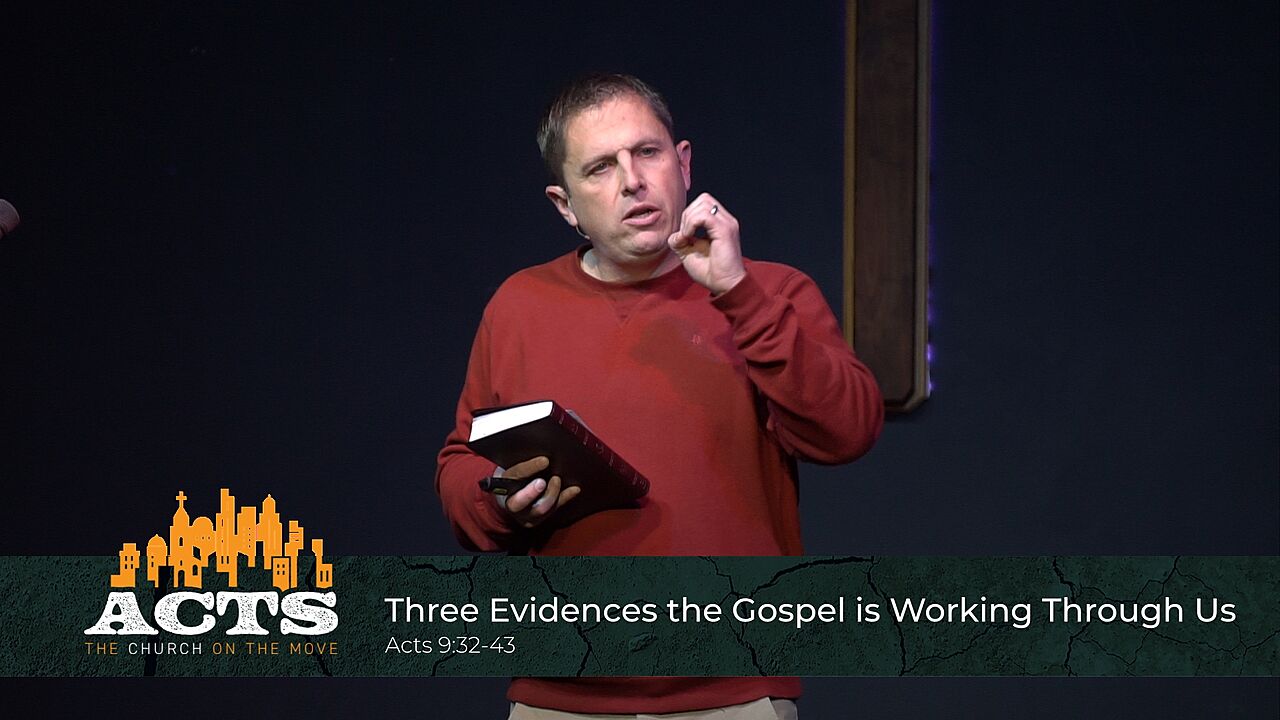
Acts 9:1-31 - From Sinner Saved to Servant Sent

I'm going to invite you to Acts chapter nine this morning. Acts chapter nine is a passage we're going to be looking at together as we're going through the book of Acts. And we're at a pinnacle moment in the story of Acts, which deals with the conversion of the apostle Paul, which I think becomes the most influential figure in all of church history. And we get to learn what took place as it relates to his conversion. And as we talk about this, I don't know why I'm on that page, but give me control. There we go. As we look at this together one of the things I want us to focus on is one, in dealing with the conversion of Paul. It's good to read what happened in his story, but also make it personal to our own lives. And just saying this, I hope we all have a conversion story. I hope we all have a moment in our life where we can look back and say, this is this is what it took for me to come to that moment where I made a decision about Jesus and where I would lay my hope in life and to understand the beauty of what Christ has done for us, the way that he's given his life, so that we can find freedom in him, that Jesus paid for our sins at the cross so that we could be forgiven and reconciled to God. He's God's done something for us that no religion could ever do.
That no matter how much you try to dull yourself up in religion. What we discover is religion really leads to two paths in life. It leads to pride or despair. It'll lead us in pride and thinking that we are everything that we, we build ourselves up to be, and that we're better than others because we're able to perform better than other people can. So we can lead us to this path of pride, or it leads us to this place of despair and saying, I can never measure up. But that's the beauty of the gospel, is that it's not about religion, but relationship with the Lord and understanding what Christ has done for us and pursuing us with relationship in him so that we can be forgiven and given a new name and new identity in Christ. Discovering the purpose for which we were created as we're discovered in Jesus, because Christ made us in his image and he remakes us at the cross. And so I hope we all have a conversion story, a place where we he trusted in the Lord. But also, I hope we understand that the Christian faith is more than a conversion story, meaning that your conversion leads you to something glorious in a relationship with God. And as you think about what your faith journey is entails, we're going to see how that unfolds with the Apostle Paul in recognizing God created me for more than just a conversion story.
And sometimes, sometimes we have this way of looking at moments in life as if they're in an end, in and of themselves. When God really uses certain things for a springboard to something greater. What I mean by that is sometimes as a as a minister, when I perform weddings, I like to remind the couple that all of this work doesn't come to the point where now you hit the wedding and everything's finished, right? That the marriage is the beginning of the beautiful journey that God desires to create. Or sometimes when we do baptisms here at the church when people are baptized. I'd like to remind people that baptism is not the end of the journey, but the beginning of something beautiful. God's doing in you as you're declaring your faith in him before other believers in Christ. And the same thing with conversion or coming to Jesus. It's wonderful when that happens in the life of people when we rejoice over that. But that begins the beautiful story of learning what it means to walk with Jesus every day. The idea of that relationship with Christ made known in your heart and through your life. And so God has created us for more than just simply conversion. But to see how that conversion story unfolds in an incredible way, and that's what we're going to talk about today, is we're going to look at the Apostle Paul's life and see how this saved sinner goes to a servant sent for the cause of Christ.
And we're going to discover practical lessons that we learn in this conversion story of the apostle Paul. And we're kind of going to do it today as a record, meaning. Normally when I share a message with you guys, I like to just three four points at most, and I don't even expect anyone's ever going to remember 3 or 4 points. My hope and prayer every Sunday is that God just stirs our heart in a way that we just take a nugget of truth that God wants to continue to use to transform our life as we follow him. But today, we're setting a record. We're going to talk about eight points. I have never done that before. But look at this conversion story. I thought to myself, man, I don't want to eliminate some of these things. Like, normally I whittle down a message. I'm like, nope, I'm leaving it all in. It's after Thanksgiving. We'll probably have a low crowd, which we don't, but I don't know. Well, who knows what's going to happen, right? So I gotta share this quickly with you. But this is one of the most powerful stories in the history of the church and what God can do. But here's the incredible thing is, like, while we might read this as a story in the Bible, we know God continues to do his miraculous work in our hearts and lives today.
So when a life is given over to the Lord completely, God does powerful things through his people. Surrender to him. So this story is important for us. So? So what? What can we learn about the Apostle Paul's conversion? Well, number one is this in your notes? God's plan for my life is bigger than my conversion. And we already talked about this together. But God's plan for my life is bigger than my conversion. And in Acts chapter nine, it starts off that way. In verse 15 when the Lord said, he's talking to Ananias here, who was an instrument God uses in leading the apostle Paul to Christ. But he says, but the Lord said to Ananias, go. For Paul is a chosen instrument of mine, to carry my name before the Gentiles, and kings, and the children of Israel. And so while God's interest is in the Apostle Paul's heart before him, God's interest is also bigger than the apostle Paul. And guys, it's the same for you and for me. I love this God's saying, look, not only do I want him to know me, but there's incredible plans for his future. He's even going to be before Kings. And, I would say the same thing for you. Like, God's got an incredible plan for your life to not only see a transformation in your heart, but also through your life and the way God wants to work, to see other lives transformed in him.
And you know, you might be a little bit unique from Paul, meaning perhaps God doesn't have a king for you to share the gospel with. I don't know very many of us that have, kings for friends, except for some of you might still think the Nigerian prince is legit. And if you do, please talk to me after the service. I'm concerned for your well-being. Right. But. But if you get an email asking for money from him, don't give it. But God certainly has a plan in your life for your life to see his glorious work made known not only in your heart, but through you. And so God is describing the bigger picture, something far more grander than just the check off the box of I accepted Jesus as my Savior and that's it. But God, God has so much more in mind with as you come to know him, what he desires to do through you. And in fact, in Acts chapter nine, verse 31, if you read the conversion of the Apostle Paul. The story unfolds in 31 verses. Verses and verse 31 kind of comes to that culmination point of what happens as Paul's converted. And it says to the church throughout all Judea and Galilee and Samaria had peace and was being built up and walking in the fear of the Lord and in the comfort of the Holy Spirit, it multiplied.
I think how incredible. I mean, one, it's communicating. Paul was such a tumultuous person to be around that when he converted, it's like, oh, let's just take a deep breath for a minute. But also, I think it's important to understand how the church is moving this thought of peace, because peace is not saying it's the absence of conflict. Sometimes when we hear the idea of peace, that's what we think. But when you consider the early church and all that they're going through, there's certainly not without conflict. I mean, anytime you gather a large group of people with different personalities, there's just going to be conflict because God made us all different. Sometimes weird, sometimes sinful. But God made us different, right? And because of that, when we bump into one another, it can create some conflict. But even more than that, when you consider the steps of the early church, I mean, they've faced persecution. They've gone through displacement of being kicked out of their homes and running for their life. There's all sorts of difficulty that they're going through, but yet there's peace. And so what we're learning is peace in this sense is not the absence of conflict, but rather the kind of peace that God gives us transcends the circumstances of this world. In fact, if the pursuit of your life is to find peace, as in the absence of conflict, we know that nothing in this world will ever truly satisfy, because in certain seasons you might find temporal peace.
But everything in this world is temporary. And if you look for this world to provide that type of peace, it will only ever disappoint. The peace that God gives us transcends the temporal of this world to something more permanent, something eternal. And when we think about in terms of peace as God's people, what we're talking about is the presence of God and the power of God through the promises of God. Saying what we have in him is always secure, and therefore it gives peace to our soul, because we know that no matter what the world throws at us, it can never be taken away. And so the early church has this peace. It's a greater story of what God's unfolding for us. In fact, I think the better way of thinking about peace is much like a harbor. I think in terms of the purpose of a of a harbor, harbors are built for the protection of the ships on the inside. Meaning once they cross out of the boundaries of the harbor, they're left into the waves. And whatever the conditions and the elements are the waves of the day. But once you come around that wall of the harbor, you're protected from the elements of the waves. And that's the idea of a lighthouse. The lighthouse worked as a beacon to sailors in the midst of the night and working through the storm, trying to find that place of solace to protect them.
And when they could see the harbor, they knew if they or they could see the lighthouse. They knew if they could get to the lighthouse, they were able to maneuver on the other side of the harbor and be protected from the waves. And when it comes to the idea of God's peace, that's what his peace brings us, is the source to sustain us in the midst of a tumultuous world. Something that transcends God's plan for my life is bigger than my conversion. God's got a beautiful story to write in me and through me. However, when we go on this faith journey, inevitably we're going to we're going to come to a tough road. And oftentimes that tough road is met in relationship with others, because not everyone's going to be in agreement with what I am doing in my faith journey with Jesus and how I am pursuing him. Not everyone is going to like that, and especially when it comes to the Apostle Paul and his conversion before he came to know the Lord, he was a rather difficult individual. In fact, it tells you in Acts chapter nine, verse one. But Paul, still breathing threats and murder against the disciples of the Lord, went to the high priest and asked him for letters to the synagogues at Damascus, so that if he found any belonging to the to the way men or women, they used to refer to Christianity as the way men and women he might bring them bound to Jerusalem.
Now, as he went on his way, he approached Damascus, and suddenly a light from heaven shone around him, and falling to the ground, he heard a voice saying to him, Saul, Saul, why are you persecuting me? You know this miraculous moment where God intervenes in the life of Saul when he's on his way to slaughter Christians and imprison Christians? But here's what we learn. Point number two grace reaches the hardest of hearts. Grace reaches the hardest of hearts. In fact, to be honest, they make the best converts, especially when you come face to face with the Holy God. Now, let me just say a couple of things here. Why was Paul so angry? I think it's worth considering because if we're going to be honest, sometimes we can get this way too. Now, we may not physically kill and murder people, but the attitude of our heart is very destructive. And what leads us to do this? Can I just tell you for the Apostle Paul, one of the things I believe that he's going through in this moment is grief. And grief has a funny way of working itself out in our lives. And one of the reasons I think Paul is going through grief is when you read passages like, for example, Philippians chapter three, verse six, it tells us that he is zealous for his faith. Paul really believes that what he's doing in this moment is honoring to God.
And he's very zealous about it, right? In a religious sense. In fact, he described the Jewish people in Romans chapter nine, verse one, in Romans chapter ten, verse one, the same way they have a zeal for God, but not according to knowledge, meaning it wasn't the true God, it was the God that they thought that they were serving, but wasn't the real God. And so Paul talks about this zeal and here's what I think is happening to the apostle Paul. He's getting to a place where he realizes his religion can't hold him. He's getting to a place where he's recognizing the holes in his theology of what he thought he believed. And when we start having things ripped apart from us that we feel is precious, we go through a period of grief. In fact, if you're familiar with the five stages of grief when someone we love dies, we often go through those stages of grief. Maybe not all of them. Sometimes you might go through all of them within a minute span. But we go through stages of grief, and it doesn't just have to be when people that we love pass away. Get this. We can also go through stages of grief when the idols of our life are passing away. There are things that we might hold precious and we want to grab hold of that.
And when we realize that they're falling apart before us and we can't do anything about it. But we still love that idol and we want to hold on to it. We'll go through those stages of grief first. We might deny it, then we might bargain with it, and then we'll go through depression, and then we'll even use anger before we finally get to acceptance. And I think this is what's happening in the Apostle Paul's life. He's angry because he realizes that his religious system is falling apart and it can't hold him. Now, I'm not saying that makes an excuse for how people behave, but here's what I want you to know. When you go into this world honoring Christ with your life. And people don't always agree with you, and sometimes they're maligning you. What they're really attacking isn't you? But rather there's a there's an inner battle that's taking place with within them, and it's just manifesting itself upon you. Now, I don't I don't want to say and then therefore that justifies everything that they're doing. But what I think it helps us do is to understand in a more compassionate way where people are coming from. Because for all of us to come to Jesus, we have to be willing to let go of everything else and say, Christ alone is worthy of my life. And so for the Apostle Paul. Grace is reaching in the hardest of hearts. And here's what I think is happening with Paul.
He's gotten so fixated on other people in this religious sense of thinking. He's performing and he's in the right and doing all of these things that it isn't until God strips him of everything, that he begins to realize. The one thing that he really needs is the Lord. In fact, it's not going to pop up on the screen here. But in verses six, seven, and eight it tells us Paul gets up from this moment and he goes into to the town Damascus, and he spends three days there, blind and without food or water. I mean, he is completely desperate. And it wasn't until God took his eyes off everything else that he realized how much he needed the Lord. Grace has this way of reaching the hardest of hearts, and it does it in two ways is one when we realize in the grace of God just how much we need him. I mean, this is where Paul, the apostle Paul gets to in life. He first he thinks, well, he's capable of doing all this in his own strength, right? His performance, his self righteousness, everything he deserves because all that he's done. And in that kind of system, he's comparing himself to other people. What's wrong with them? Why can't they look at me? How great I am. But the life of the believer or our lives in general? We could say it like this. It's not a game of comparing yourself to others, but rather it's about recognizing who you are before a holy God and before a holy God.
The Bible is very clear that we're sinful people and he is a just God. He's perfect, and there's nothing that you can do before a holy God to take away your sins. And therefore before him you have his wrath. But in the midst of your sins, God didn't give up on you. He still loved you. He pursued you. He even gave his life for you on the cross as a sacrifice for your sins. He became your sin so that you could be in his freedom. You get to walk in the beauty of Jesus. I mean, that's the gospel message. So not only does grace help me recognize how desperate I am for the Lord, but his grace also delivers me and the beauty of who Christ is, that I could find freedom in him. And so the hardest of hearts are transformed. It's not because of what I've done, but because of what he's done on my behalf. And number three. Then, as grace reaches the hardest of hearts, we learn this. To persecute the church is to persecute Christ. To persecute the church is to persecute Christ. And this is what we find with the Apostle Paul is he's journeying on this road. It says in verse five. And he said, who are you, Lord? Paul asks this great light that appeared to him, who are you, Lord? And he said, I am Jesus, whom you are persecuting.
Guys, there's a couple of things here that I think is incredible to consider in what Jesus is saying. Jesus is so connected to his body, the church, that he sees any attack against them as attack against him. Now, this is an incredible thought to consider one one as a group corporately in Jesus, that he cares about us as a body that way, that anything brought against you is an affront first against him. He sees himself that integrated into what the body of Christ is. But also you can think about it in an individual sense in your own faith journey. How do I know God loves me? How do I know God cares about me? Well, he correlates what you're going through in this life as if he himself is walking through that. And I think this is this is incredible for us to consider and the tender care of our presence before the Lord and the way that he sees you. It's wonderful. In fact, in passages like the book of Hebrews, it tells us if a brother and sister in Christ suffers in this world, we as a body of believers should suffer with him in the sense that we're saying we're connected to one another and the beauty of what Jesus desires to do. So no matter what the world brings against his people, we get to walk with an understanding that Jesus sees me.
Jesus cares about me. Jesus loves about what loves us as a body and what we're walking through in this moment. And then I could say, on the other side of the coin, how you treat the body matters because Jesus sees this as his bride. You know, one of the things that I like to think, for the most part, I'm a pretty even keeled kind of guy. But I will promise you if you ever try to do anything to my wife, you'll have to kill me before I stop. Right? And the reason for that is I love her. And to attack her is to attack me. And I care about her, and I want to honor her. And I don't want other people to dishonor her. And so I want to be mindful of that in moving this world. And to be honest, if you want to show appreciation towards me, the best way to do that is to love my wife, right? Like, I mean, I'm nice. I care when people do nice things. I mean, that's wonderful, but when my wife feels honored, loved and appreciated, I feel loved, honored and appreciated in that and even in our church. Like we know when it comes to our families, one of the best ways to love our families is to do a good job at loving the kids. Because by loving our children, we also love the parents.
And parents feel appreciated by the way their kids are cared for. And when you think about the body of Christ, this is what Jesus is saying. This is his bride. And if you want to love Jesus, one of the best things you could do is His honor, his bride. That's what makes a gathering like today so important for us as a people to not not just see it as somewhere I just show up and check in, check out. But to think about how God can use me, even in this hour, to encourage people around me for what God desires to do in their life. This is Jesus's bride, and there's nothing more sacred than this because Jesus gave his life for you. And so what Jesus is saying here is incredibly profound and important for us to think about, and the implications of our own steps in life, and how I see God's will working in my heart as I minister to what Jesus cares about and what Jesus cares about, first and foremost is his church. So to persecute the church is to persecute Christ. Number four is this conversion is a complete life reorientation. Conversion is a complete life reorientation. And you see this throughout the story, but I'm only going to highlight it in verse five and six. But as Paul's going in this journey and he's fixated on his own things, suddenly God directs his attention and Paul asks this question in verse five, who are you, Lord? And I think this is a this is a very important question that Paul asks, but I don't think this is the only time Paul asks this question.
I think Paul continue to ask this question for the rest of his life. Now, I think this was a question that continued to be refined because he became more aware of who the Lord really was, but it was a question he got never he never got tired of asking. Because this journey that we're on with the Lord is a relationship journey. It's organic. We get to grow in this. And so this is a question not only that Paul should ask all of his days, but all of us should ask all of our days. Lord, teach me your ways. Let me understand who you are, not just know about you, but to intimately know you. And then God says this. He said, I am Jesus whom you are persecuting. But rise and enter the city, and you will be told what you are to do. So this is Paul's life now being redirected to really one master, one lord, one leader guiding him. And if we're not careful in the way that we live our lives, we could live our lives with many masters and in so doing, live our life to try to please everyone and everything. And in doing that and following that kind of road, you will never find your life's purpose. You will never find your life content because you can never please everyone, and you will always disappoint people's expectations of you.
And you were not made to please everyone. In fact, God created you for one purpose and that is to live for his glory, to live your life for an audience of one. And it's not until your life is given over to him that you'll truly fulfill the purpose for which you were created, which is in him. And so this is Paul reorienting his life to that purpose. Every once in a while as a pastor, I get a little bit befuddled. By the way, sometimes people are phrasing questions and what I'll call their faith journey. Meaning, sometimes it is easy for us to revert our faith journey into religious ways of thinking rather than just relational thinking. And sometimes there'll be a way in which we live, where we don't really have a relationship with the Lord, but we just know there's certain things that Christians do, and we just want to show up to check that box so we can quote, please, the Lord. And so, I'll have my conversion. I surrender to Jesus. But then I'll show up to church on Sunday because, well, that's what a good Christian does, and I should probably be baptized. But that's because, well, that's a step Christians should take. And I'm just going through this religious process in order to make God happy. And let me just tell you, when it comes to a faith journey, we don't we don't go through a process in order to, quote, finally, make God happy with us as believers, we do things in the Lord because we have found our joy solely in him.
God, I want to know you. I want to follow you, and I want to gather together on Sunday. It's something I'm looking forward to because I know the intimacy of this people, the that you have given your life for and what you want to do in their hearts and lives. And I get to be a part of encouraging your bride what you love. And I get to proclaim that to the world by being baptized and just saying, I'm following Jesus. This is not this is not about checking the box. It's about enjoying the journey of the relationship that I have in Christ. And so this is what the Apostle Paul is learning to do, is reorienting his life towards that one purpose. And number five, and I gotta move a little faster, is this God works through ordinary, faithful disciples. God works through ordinary, faithful disciples. It says in verse ten, now there was a disciple at Damascus named Ananias. And the Lord said to him in a vision, Ananias. And he said, here I am, Lord. And the Lord said to him, rise and go to the street called straight in the house of Judas. Look for a man of Tarsus named Saul, for behold, he is praying.
And when he had seen in a vision a man named Ananias come in and lay his hands on him so that he might regain his sight. But Ananias answered, Lord, I have heard from many about this man, how much evil he has done to your saints at Jerusalem. And here he has authority for the chief priests to bind all who call on your name. But the Lord said to him, go, for he is a chosen instrument of mine, to carry my name before the Gentiles, and kings, and the children of Israel. So here's Ananias. I'm just going to kind of tease this. We don't know a lot about Ananias. In fact, if you looked up the word Ananias in the rest of Scripture, like, okay, this is a great passage on Ananias. God, show me more things about Ananias in the Bible. And you look in the Bible for more things about Ananias. You know what else you find about Ananias? Nothing. Absolutely nothing. He's the he, in fact. And when you read this story, you realize Paul's on his way to Damascus to kill Christians. Christians are aware of this. So there's probably no one left in Damascus except for this guy. I know who this guy is. This is the guy that no matter what time you tell people to show up, he's always 15 minutes late because he's the last one to get out of Damascus. That's how he gets picked, right? He's like God's like, I need a person.
Oh, there's only one Christian left. It's you. Ananias, right. The only thing we know about Ananias in the story is that he's a disciple of Jesus. That's it. He's a follower of Jesus. And we might also know he's probably usually late for everything he goes to. We may be that, too, but. But he's just a follower of Jesus. And can I just tell you guys that's exactly how the Lord wants to work. He does extraordinary things through ordinary people. In fact, if you were to read the book of Corinthians, one of the things you find that Paul compares ourselves to is jars of clay. He compares the you and I as followers of Jesus to jars of clay. And if you do a little deep dive in the Greek, you're like, oh, teach me about these jars of clay. Are these special, unique jars? No, no, they're just common little pots. Just fragile little pots that can break. You might use it to wash dishes. You might use a pot for you going to the restroom. They're just the common, ordinary pot. That's what God describes us as. But here's the point. It's not about the pot, but about what goes into the pot. And the Lord filling your life. That's what makes you extraordinary. It's not about you, but about him and doing things for the Lord. If it were all about you impressing people, guess who gets the glory in that? But because God uses ordinary things, it's him who unmistakably gets the glory.
I mean, even when it comes to me as a pastor, if you just if I if I were just a little candid for a moment, I'm getting to that point now. I've got four boys in my house. Two of them are teenagers. Third one's about to be a teenager. Can I just tell you a common prayer for me? God help my kids follow you. Help my kids be faithful to you, Can I just tell you a common prayer as an individual? Lord, help me be faithful to you. Or even in my home with my wife. Lord, help me honor my bride. I want to honor Jesus with my life. But. But I'm just a person. It's the same for you. And that's exactly what God uses. Ordinary people doing extraordinary things because. Not because of us, but because of Christ. Number six. Suffering is a part of the calling. Suffering is a part of the calling. For I will show him how much he must suffer for the sake of my name. And I go share with Paul. I can't help but think that this is part of the incentive. Don't worry, Ananias. I'm going to make him suffer. Like. Okay, I'll do it now. God. But suffering is a part of the journey. And one of the one of the reasons I love bringing this point out is because I think in American Christianity, we don't really have much vocabulary room for this because sometimes.
If we're not careful, we'll reject Jesus for our creature comforts. Because if we're honest, what's more important to us is our creature comforts. We'll follow Jesus when it's convenient to follow Jesus, but not when the S word is used. Suffering. There is a. If I just summarize this quickly. In the 1800s, there was a lady by the name of Fanny Crosby, and Fanny Crosby did some extraordinary things with her life. It's thought that Fanny Crosby wrote at least 8000 hymns in her life, and some think as many as 9000 or more, because she often wrote hymns under a pseudonym. So Fanny Crosby in the 1800s wrote about 9000 hymns with her life, and she was a popular songwriter during the day. Take, take whatever you're famous Christian artist is that you like today? Multiply the popularity by three. And that's Fanny Crosby, right? Fanny Crosby in the 1800s was that famous of a of a Christian hymn writer, she wrote probably our most famous hymn was Blessed Assurance. But the most interesting thing about Fanny Crosby is that she did it all blind. Fanny Crosby was blind from infancy. She never saw a sunrise. She never saw her mother's face. She was blind. People would often ask her if. If you could see, would you. Would you ever want to see? And I just want you to know you never have to ask any blind person that question.
The answer is always yes. Okay. If you have the ability to see, you would want to be able to see. But she would respond to that in an incredible way. She would say it like this. Even though she may want to see she would say it like this. You know, if I did have the ability to see, I most likely would have never written any of these hymns. Her blindness wasn't what prevented her in life. It was actually what fueled her to do what God had created her for on this earth. God used that adversity to challenge her to overcome those obstacles, to do incredible things, to encourage the body of Christ and to glorify the Lord. It was the blindness because it's the same thing with suffering and suffering for us as people. I'm not saying we need to line up for suffering, but when there's struggle in the faith, that's how you know your faith is genuine. When you're willing to say, and I still choose Jesus, you're demonstrating that what matters to you more than anything is Christ. Fanny Crosby, when she would talk about that, she would also add some sweetness even further to the to her thoughts. And she would say this. And one day when I see again, it's going to be when I'm in heaven. And the first thing that I'm going to see with my eyes is my savior. You think how incredible, in the midst of struggle that the beauty of Christ is made known.
I need to give these last couple points in two minutes here. But number seven is this the Holy Spirit transforms us immediately. And you see this with the Apostle Paul, as God makes himself known in the heart of the apostle Paul says in verse 18. And immediately the scales fell from his eyes, and he regained his sight. Then arose and was baptized, and took food, and was strengthened. For some days he was with the disciples at Damascus. And immediately he proclaimed Jesus, look, in order to follow Jesus in order to serve Jesus, you don't have to have everything perfected in Jesus. What you do is just start honoring Jesus where you're at. And when God does that work in us, we want to continue to just see it made known in the way that we live our lives. And let me give you the last point, because I gotta close here. Last is this fear is often the greatest obstacle to experience God's blessing. Fear is the greatest obstacle to experience God's blessing. Verse 26. When he had come to Jerusalem, Paul, he attempted to join the disciples, and they were all afraid of him, for they did not believe that he was a disciple. But Barnabas took him and brought him to the apostles, and declared to him, how on the road he had seen the Lord who spoke to him, and how at Damascus he preached boldly in the name of Jesus.
Let me just say this. I can imagine what this story would look like without an Ananias and Barnabas, individuals that were willing to step in for the sake of glorifying God to the benefit of others, could imagine what Paul's life would have been without an encourager by his side. And there are a lot of reasons to be concerned in this world, but there's an even greater reason to live for the Lord, and that is because you have the Lord with you wherever you go. You can let fear dictate who you are, or you can let Christ. Barnabas. It just took one. One person and the world in the first century was turned upside down by a life who radically lived for Jesus. Because when it comes to your life, One bold step in Christ, and God does incredible things. I'll close with this. There was a story in the 1960s by a man named Francis Powers. He was he was a pilot for the military during the Cold War. And he went down behind enemy lines and was captured. And during that time, 1962, in fact, there was a man by the name of James Donovan who was appointed to help bring about his release, and he had to go behind the wall in East Berlin in order to bring about that release. And everyone was nervous for him. In fact, people were worried if you go over that wall, you're not coming back.
And they try to encourage him not to do it. And when it came to James Donovan, one of the things that made him unique is that this was just a guy who happened to be at the right place at the right time. He wasn't a politician, he wasn't a spy. But he found himself in a situation where he got to broker this deal to try to get this guy released, and he's come to those moments where he could have lived in fear. This is what he said. He said, if I let fear make the decision, then fear becomes my master. And I think this became a movie. I think Tom Hanks was eventually played a part in something that had the word bridge in it. I can't remember what the movie was called, but this individual stepped in boldness and was able to broker the release of this American soldier that was held captive. And I think that's it's a wonderful story to see how that unfolds. But I just think there's even more incredible things that God desires to do in a life given over to him. What's going to dictate and determine your steps? You're going to let other masters lead you, or you're going to let the master guide you, the one who intimately cares about every step of your life, the one who created you in his image and recreates you at the cross.